Note: Consult a doctor for health advice. Check out my favorite health products here: (Amazon Affiliate commission applies)

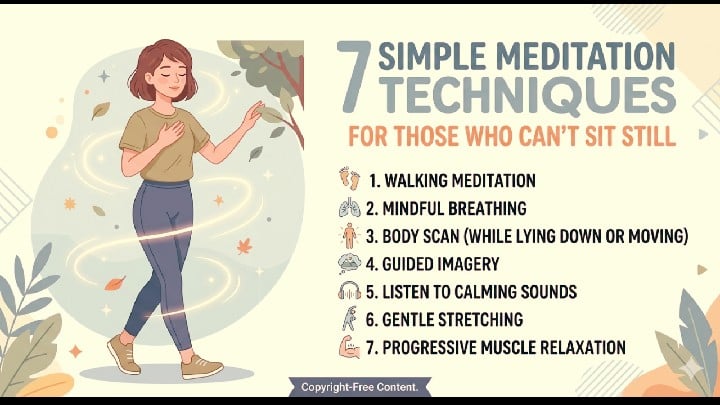
7 Simple Meditation Techniques for Those Who Can’t Sit Still
Discover 7 simple movement-based meditation techniques that help you calm your mind without the need to sit still. Perfect for those who find traditional meditation challenging.7 Simple Meditation Techniques for Those Who Can’t Sit Still
MEDITATION
Rajesh Kumar
5/31/20266 min read
I have a confession to make. A few years ago, I decided to become one of those zen people. You know the type. They wake up at five in the morning, light a stick of incense, sit cross-legged on a fancy pillow, and clear their minds for an hour.
So, I bought the pillow. I turned off my phone. I sat down, crossed my legs, and closed my eyes.
Do you know what happened? Within exactly forty seconds, my left foot went completely numb. My nose started itching like crazy. My brain started screaming at me about a random email I forgot to send in 2018. Then, I began thinking about what I wanted to eat for lunch. It was a total disaster. I felt like a massive failure because I just could not sit still.
My dear friends, if you relate to this story, I want you to take a deep breath right now. Drop your shoulders away from your ears. You are not broken, and you do not suck at meditating. The truth is, the traditional way of meditating does not work for everyone. Some of us have bodies that crave movement and minds that run a million miles an hour.
In my experience, trying to force a naturally fidgety person to sit perfectly still is like trying to force a puppy to sit in a corner during playtime. It just backfires.
The good news is that you do not have to sit like a statue to find some inner peace. You can move, you can look around, and you can actually use your nervous energy to calm your brain. **Without further ado, let's proceed** to the good stuff.
Here are seven super simple techniques that will help you calm your mind without forcing you to sit still.
The Magic of Walking Meditation
If your legs get twitchy the second you sit down, then do not sit down. Walk instead!
Walking meditation is an amazing tool for anyone who feels trapped by a meditation cushion. You do not need a special mountain trail for this. You can do it in your living room, down your hallway, or around your backyard.
Here is how you do it:
Slow down your pace:
Walk at about half your normal speed.
Focus on your feet:
Notice how your heel hits the floor first. Then feel the weight shift to the middle of your foot. Finally, feel your toes push off the ground.
Match your breath to your steps:
Take two steps as you breathe in, and take two steps as you breathe out.
I love doing this when I feel overwhelmed by a massive to-do list. Just five minutes of walking back and forth in my kitchen helps me clear the cobwebs out of my head. Your body stays happy because it is moving, but your brain gets a chance to rest.
Breath Counting for Fidgety Minds
Sometimes our minds wander because breathing normally is just too boring. **I feel that** our brains often need a tiny, simple job to keep them occupied so they don’t start worrying about the future. That is where breath counting comes in handy.
Instead of just watching your breath, you are going to count it. This gives your brain a bone to chew on.
Inhale (1) -> Exhale (2) -> Inhale (3) -> Exhale (4) -> Restart at 1
I have observed that if you try to count all the way up to one hundred, you will lose track by number twelve. That is totally normal! To keep it easy, only count up to four.
Breathe in and think *one*. Breathe out and think *two*. Breathe in and think *three*. Breathe out and think *four*. Once you hit four, start right back over at one. If you lose track and realize you are suddenly at number twenty-seven, just smile, forgive yourself, and start over at one.
Finger Tapping to Release Anxious Energy
**As far as reality is concerned**, we carry a ton of stress in our hands. Think about how often you clench your fists or tap your fingers on your desk when you are stressed out. You can turn that exact nervous habit into a beautiful, calming practice.
Let's explore this now, because you can do this technique anywhere—even during a stressful meeting, and nobody will even notice.
Take your thumb and firmly press it against your index finger. Then move your thumb to your middle finger, then your ring finger, and finally your pinky finger.
As you touch each finger, say a short phrase in your head. You can choose any four words you like. Here are a few examples that I love:
* "Peace begins with me."
* "I am safe now."
* "Just breathe out stress."
* "Calm down right now."
Press one finger for each word. Index finger: *Peace*. Middle finger: *begins*. Ring finger: *with*. Pinky finger: *me*. Then repeat the loop. This physical action gives your hands something to do, while the words give your mind a positive place to land.
The Five Senses Grounding Trick
When your mind is spinning out of control, it is usually because you are stuck inside your own head. You are worrying about what happened yesterday or stressing over what might happen tomorrow. This technique forces you to snap back into the present moment by using your five senses.
You can do this while sitting in a chair, standing in line at the grocery store, or lying in bed. Look around your room and quietly name these things to yourself:
1. Five things you can see:
Look for tiny details, like a crack in the wall, a spot on the carpet, or the way the light hits a picture frame.
2. Four things you can feel:
Notice the weight of your clothes on your shoulders, the hard floor under your feet, or the rough texture of your jeans.
3. Three things you can hear:
Listen closely for distant traffic, the hum of the refrigerator, or a bird chirping outside.
4. Two things you can smell:
This can be tricky, but look for the scent of your laundry detergent or the leftover coffee on your desk.
5. One thing you can taste:
Notice the minty taste of your toothpaste or just the neutral taste in your mouth.
By the time you finish this list, you will notice that your heart rate has slowed down. You brought your mind back to the physical world, and that is exactly what meditation is all about.
Mindful Chores Like Washing the Dishes
Yes, you read that correctly. You can absolutely use your daily chores as a form of meditation. In fact, doing chores mindfully is one of my absolute favorite ways to ground myself when I am feeling frantic.
Let's take washing the dishes as an example. Usually, we scrub dishes as fast as possible because we hate doing it and want to finish quickly. Next time, try to do the exact opposite. Slow down and pay attention to every single detail of the task.
Feel the warm water running over your hands. Look at the way the soap bubbles catch the light and create tiny rainbows. Listen to the clinking sound of the plates and the rushing water. Notice the clean, fresh scent of the dish soap.
When you focus entirely on the chore, the chore stops being a boring task. It becomes a peaceful break for your brain. You can do this while folding laundry, vacuuming the rug, or brushing your teeth.
Scribble and Release Drawing
Many people think meditation requires complete stillness, but creative movement works beautifully too. If your hands need to stay busy, grab a plain piece of paper and a pen.
Close your eyes, or just soften your gaze so you are looking loosely at the paper. Place the pen on the page and just start drawing lines. Do not try to draw a pretty picture of a house or a flower. Just let your hand move across the page in loops, zig-zags, and scribbles.
Match your movements to your feelings. If you feel angry or anxious, your lines might be sharp and fast. If you feel tired, your lines might be slow and curvy.
Let all of that built-up, jittery energy flow directly out of your arm, down through the pen, and onto the paper. You are literally moving the stress out of your body. After a few minutes, take a look at your messy scribble, take a deep breath, and crumble the paper up if you want to!
Sound Tracking for Fidgety Listeners
If closing your eyes makes your brain scream with loud thoughts, try opening your ears instead. Sound tracking is a method where you act like an audio detective.
Sit comfortably or stand up. Close your eyes if that feels good, or keep them open and stare at a spot on the floor. Now, try to listen for the absolute farthest sound you can possibly hear. Really strain your ears. Is it an airplane high up in the sky? Is it a car driving down a highway miles away? Focus on that distant sound for a few moments.
Next, bring your attention a little closer. Listen for sounds right outside your building. Maybe someone is walking by, or the wind is rustling some tree leaves.
Finally, bring your attention inside your room. Can you hear the ticking of a clock? Can you hear your own breath?
By shifting your focus from far away to up close, you train your brain to pay attention to reality instead of its own anxious thoughts.
Meditation does not belong to a select group of people who can sit perfectly still for hours. It belongs to anyone who wants a little more peace in their daily life.
Do not try to force yourself into a shape that does not fit you. If you need to walk, then walk. If you need to tap your fingers, then tap your fingers. Pick just one technique from this list today and give it a shot for two short minutes. You might be surprised by how wonderful it feels to find calm in the middle of your movement.
Do you have a favorite way to calm your mind when you feel restless?
Contact
rkyogablog@gmail.com