Note: Consult a doctor for health advice. Check out my favorite health products here: (Amazon Affiliate commission applies)
Best Books on Yoga Philosophy Every Yoga Teacher Should Read
Discover how philosophy books can enrich your yoga classes. From ancient yoga sutras to modern wisdom, explore personal favorites that enhance teaching and deepen understanding. Let's fill your wisdom well together!Best Books on Yoga Philosophy Every Yoga Teacher Should Read
YOGA GEAR
Rajesh Kumar
4/20/20266 min read
Hey there! I’m so glad you’re here. My dear friends, if you’ve recently finished a teacher training program or you’re just starting to lead your own classes, you probably know that "imposter syndrome" feeling. You stand at the front of the room, everyone is looking at you, and suddenly you realize that yoga is a lot more than just touching your toes or holding a plank. I remember my first month of teaching like it was yesterday. A student came up to me after class and asked, "How do I take this feeling of peace into my stressful office job?" I froze. I could tell her where to put her feet in a lunge, but I didn't have the words for the "why" behind the practice.
In my experience, that’s the moment you realize you need to hit the books. But not the anatomy books—the philosophy ones. Yoga philosophy is the soul of what we do. It’s what turns a gym workout into a life-altering practice. I feel that as teachers, we have a responsibility to keep learning so we can offer our students something deeper than just a good sweat.
Without further ado, let’s proceed into the library of some truly life-changing reads that will make you a more confident, grounded teacher.
Why the Yoga Sutras of Patanjali are the ultimate guidebook
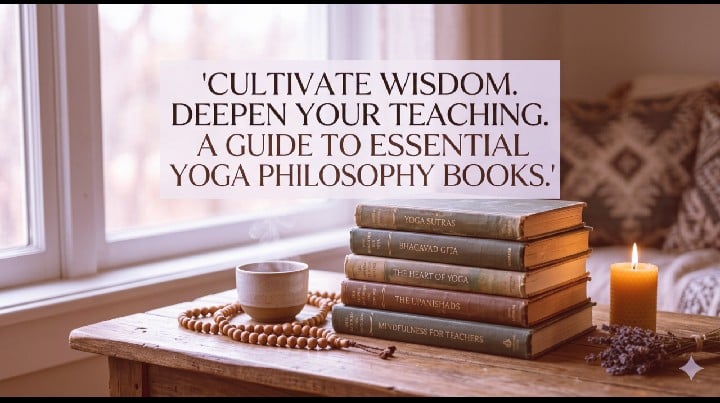
As far as reality is concerned, you really can’t call yourself a yoga teacher without owning at least one copy of the Yoga Sutras. I personally recommend the translation by Swami Satchidananda. It’s the "big blue book" you see in almost every studio, and for good reason.
I have observed that many new teachers find the Sutras intimidating. They think it’s going to be this dry, academic text that’s impossible to understand. But Satchidananda writes like he’s sitting right there on the porch with you, sipping tea. He breaks down the 196 aphorisms into bite-sized pieces of wisdom.
Let's explore this now: the Sutras are basically a manual for the mind. Patanjali doesn't spend a lot of time talking about poses. Instead, he talks about how to stop the "chatter" in our heads. For a teacher, this book is gold for class themes. You can take one single sutra—like Ahimsa (non-violence) or Santosha (contentment)—and build an entire month of classes around it.
I remember one time I was feeling super overwhelmed by my schedule. I opened the Sutras to the section on Asteya, which means non-stealing. It reminded me that by rushing and not being present, I was stealing time from myself. I shared that little thought with my 6:00 PM Vinyasa class that night, and you could hear a pin drop. People need this stuff. They are hungry for it.
Understanding the Bhagavad Gita and its impact on your life
If the Sutras are the "how-to" manual, then the Bhagavad Gita is the "why" story. My favorite version for western readers is by Stephen Mitchell. He uses such clear, beautiful language that it reads more like a poem than a dusty old scripture.
The story takes place on a battlefield, which I feel is a perfect metaphor for our daily lives. We all have "battles" going on—decisions to make, fears to face, and doubts about our path. The main character, Arjuna, is having a total meltdown because he doesn't want to fight. His guide, Krishna, spends the whole book explaining why he must act and how to do it with a heart full of love and detachment.
In my experience, the Gita helps teachers explain the concept of Dharma, or your life’s purpose. It teaches us that we aren't entitled to the "fruits" of our labor; we are only responsible for the work itself. This is a huge lesson for teachers! Sometimes you’ll teach a class and only one person shows up, or maybe someone leaves halfway through. If you’ve read the Gita, you know that your job is just to show up and teach with your whole heart, regardless of the outcome. It takes so much pressure off your shoulders.
The Heart of Yoga and why every teacher needs it
Now, if you want something that bridges the gap between ancient philosophy and modern practice, you have to get T.K.V. Desikachar’s The Heart of Yoga. This book is a staple for a reason. Desikachar was the son of Krishnamacharya, who is basically the grandfather of modern yoga.
What I love about this book is how human it feels. It focuses on Viniyoga, which is the idea that yoga must be adapted to the individual, not the other way around. I have observed that many new teachers try to force their students into "perfect" shapes. Desikachar reminds us that a person who can’t touch their knees can still do "perfect" yoga if they are breathing and present.
The second half of the book includes a full translation of the Yoga Sutras, but with Desikachar’s unique commentary. It’s a bit more practical and less "monk-like" than Satchidananda. He also includes chapters on breath (pranayama) and meditation that are super easy to explain to your students. I feel that this book helped me stop being a "pose instructor" and start being a "yoga teacher."
Exploring the roots of ancient wisdom in The Upanishads
If you really want to go deep—and I mean deep—you need to look at The Upanishads. I recommend the version by Eknath Easwaran. He has a way of making these very ancient, mystical texts feel relevant to someone living in 2026.
The Upanishads are part of the Vedas, the oldest scriptures of Hinduism. They deal with the big questions: Who am I? What is the soul? What is the nature of the universe? While the Sutras focus on the mind, the Upanishads focus on the spirit.
Let's explore this now: one of the coolest concepts in these texts is the idea of "Tat Tvam Asi," which translates to "Thou Art That." It’s the idea that the spark of the divine is inside every single person. Imagine how your teaching would change if you looked at every student in your room—even the ones who complain or show up late—and truly saw that divine spark in them. It changes your energy. It makes you more patient and more compassionate.
Modern Yoga Philosophy books for real-world application
Sometimes we need a modern voice to help us translate these old ideas into our busy lives. For that, I always recommend Judith Hanson Lasater’s Living Your Yoga.
I love Judith’s writing because she is so relatable. She talks about the struggles of being a mother, a wife, and a professional, and how yoga fits into all that. She takes concepts like "patience" or "discipline" and gives you practical exercises to try during your day—like while you're standing in line at the grocery store or stuck in traffic.
In my experience, students love it when you share these "off the mat" tips. It shows them that yoga isn't just something you do for 60 minutes in a studio; it’s a way of life. I’ve used her "living your yoga" prompts as the closing thought for many of my classes, and people always come up afterward to tell me how much it resonated with them.
Another great one is Erich Schiffmann’s Yoga: The Spirit and Practice of Moving into Stillness. Erich has this very "laid back California" vibe that I find super refreshing. He talks about "listening" to your body and following your own inner guidance. He encourages teachers to stop following a script and start teaching from their own lived experience. This book gave me the permission I needed to trust my own voice.
Bringing the wisdom into your classes
You might be thinking, "Okay, this sounds like a lot of reading. How do I actually use this?" My dear friends, don't try to read them all at once. Pick one that calls to you and just read a page or two every morning.
I feel that the best way to share philosophy is to keep it simple. Don't go into a class and start lecturing about 5,000-year-old history. Instead, take a tiny nugget of wisdom you read that morning and weave it into the practice.
For example, if you’re reading about Aparigraha (non-attachment), you might say at the beginning of class: "Today, let’s practice letting go of what we think this pose should look like. Let's just be with how it actually feels." That’s yoga philosophy in action! You don't even have to use the Sanskrit word if you don't want to. You're just sharing the heart of the teaching.
I have observed that the most popular teachers aren't the ones who can do the craziest arm balances. They are the ones who make their students feel seen, heard, and inspired. When you study these books, you’re filling up your own "wisdom well." And when your well is full, you have so much more to give to your students.
I really believe that being a student is the most important part of being a teacher. The moment we stop learning is the moment our teaching starts to feel stale. So, grab a highlighter, find a cozy chair, and start diving into these classics. Your students will notice the difference, and more importantly, you’ll feel a lot more connected to this beautiful tradition we get to share.
Happy reading, and I'll see you on the mat!
Contact
rkyogablog@gmail.com