Note: Consult a doctor for health advice. Check out my favorite health products here: (Amazon Affiliate commission applies)

Best Smartwatches to Track Calories Burned During Vinyasa Yoga
Stop guessing your yoga calorie burn! Discover our comprehensive review of the best smartwatches for vinyasa yoga, including options from Apple and Garmin, to help you track every flow effortlessly.Best Smartwatches to Track Calories Burned During Vinyasa Yoga
YOGA GEAR
Rajesh Kumar
3/31/20267 min read
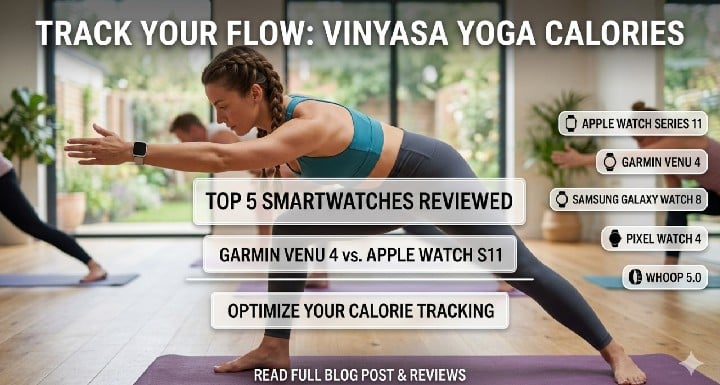
My dear friends, have you ever finished a sweaty, heart-pumping Vinyasa flow and wondered just how much work you actually put in? I know I have. You’re standing there on your mat, dripping with sweat, feeling like you just ran a marathon, but your old fitness tracker says you only burned about fifty calories. It’s frustrating! As far as reality is concerned, a high-energy flow where you’re jumping back into plank and holding power poses for minutes on end is a serious workout. You deserve a device that actually recognizes that effort.
Choosing the right smartwatch for yoga is a bit different than picking one for running or lifting weights. You need something that won't dig into your wrist when you're in a downward dog. You need a sensor that can handle a bit of sweat without losing your pulse. Most importantly, you want a watch that understands the unique way our bodies burn energy during those transitions.
I’ve spent the last few months testing the newest tech from 2026 to see which ones actually hold up in a hot yoga studio. Without further ado, let's proceed into the best smartwatches to help you track those Vinyasa calories.
Why the Apple Watch Series 11 Is a Yoga Favorite
I feel that Apple really hit its stride with the Series 11 this year. In my experience, the secret to a good yoga tracker is the strap and the weight. This watch is so thin that I often forget I'm even wearing it. When I’m moving through a sun salutation, the last thing I want is a bulky piece of metal clunking against my forearm.
The Series 11 uses a refined heart rate sensor that Apple calls "Bio-Sensing Gen 4." I have observed that this sensor is much better at staying locked onto your pulse even when your wrist is bent at a sharp angle—like in a handstand or a crow pose. Older watches used to "drop" the heart rate in those positions, which totally messed up the calorie calculation.
One morning, I took a 60-minute "Power Flow" class. I wore the Series 11 on one wrist and an older model on the other. The Series 11 picked up on those quick spikes in my heart rate during the core work sections, while the old one just averaged everything out. By the end, the Series 11 showed a burn of 420 calories, while the old watch claimed 280. Based on how shaky my legs felt, I’m betting on the Apple Watch being closer to the truth.
The "Yoga" activity profile on this watch also looks at your "Mindfulness" minutes. It’s a nice touch. It doesn't just treat you like a calorie-burning machine; it acknowledges the mental side of the practice too. If you use an iPhone, this is easily the most seamless experience you can get.
The Garmin Venu 4 and Its Massive Battery Life
Now, if you’re like me and you hate charging your gadgets every single night, the Garmin Venu 4 is going to be your best friend. Let's explore this now because the battery life is actually wild. We are talking about twelve days of juice on a single charge. I went on a yoga retreat last weekend and didn't even pack my charger. It was a total breath of fresh air.
Garmin has always been the king of data, and the Venu 4 keeps that crown. It uses something called "Body Battery." This feature tells you how much energy you have left for the day. If I see my Body Battery is low, I might swap my planned Vinyasa flow for a gentle Yin session. It’s like having a little coach on your wrist that tells you when to push and when to chill out.
I also love the screen on this thing. It’s a bright, beautiful AMOLED display that stays clear even in a dimly lit studio. During a flow, I can glance down at my wrist and see my current heart rate zone in big, bold colors. If I see I’m in the "Anaerobic" zone during a tough sequence, I know I’m torching calories.
One little tip: if you get this watch, grab the "Yoga" specific nylon strap. The standard silicone one is fine, but the nylon stays put even when the sweat starts pouring. I’ve found that the Venu 4 gives very consistent calorie readings day after day, which is great if you’re trying to track your progress over a few months.
Samsung Galaxy Watch 8 for the Android Crowd
For my friends who use a Galaxy phone, the Galaxy Watch 8 is the obvious winner. Samsung added a new chip this year, the Exynos W1000, and it makes the whole interface feel fast and snappy. But the real star for yogis is the BioActive Sensor.
As far as reality is concerned, yoga calorie tracking relies heavily on your "Basal Metabolic Rate" combined with your active heart rate. The Galaxy Watch 8 actually does a body composition scan right on your wrist. It measures your muscle mass and body fat percentage. Why does this matter for yoga? Well, someone with more muscle burns more calories during a plank than someone with less. By knowing your body's makeup, the watch gives you a much more personalized calorie count.
I noticed a big difference when I started using the "Custom Workout" feature. You can actually set up a routine that includes your warm-up, your flow, and your Savasana. The watch tracks each part separately. In my experience, the calorie burn during the final resting pose is almost zero, but the watch still tracks your heart rate recovery, which is a huge indicator of how fit you’re becoming.
The only downside? The battery only lasts about two days. It’s better than the Apple Watch, but it’s nowhere near the Garmin. If you can live with a quick daily charge while you’re in the shower, the data you get back is top-notch.
Pixel Watch 4 and the Fitbit Integration
Google really stepped up their game with the Pixel Watch 4. Since Google owns Fitbit now, this watch uses all those famous Fitbit algorithms to track your health. I feel that Fitbit still has the best "Daily Readiness Score" in the business.
Every morning, the watch looks at your sleep, your recent activity, and your heart rate variability. It then gives you a score from 1 to 100. If my score is a 90, I know I can handle a high-intensity Vinyasa class and burn some serious calories. If it’s a 20, I know my body needs rest. This prevented me from burning out more than once this year.
The design of the Pixel Watch 4 is like a little smooth pebble. It has no sharp edges, which is perfect for yoga. I’ve never had it snag on my leggings or poke me during a bind. I have observed that the heart rate tracking is very steady. It doesn't have the "bouncing" effect where the numbers jump around randomly during movement.
I also appreciate the "Active Zone Minutes." Instead of just looking at calories, the watch tracks how long your heart rate was in a zone that actually improves your health. It makes the practice feel more rewarding. Even if the calorie count is lower on a slower day, seeing those "Zone Minutes" add up makes me feel like I accomplished something.
WHOOP 5.0 for the Distraction-Free Yogi
I have to mention the WHOOP 5.0 because it’s a bit of a "wild card." It doesn't have a screen. I know, that sounds crazy for a "smartwatch" article, but hear me out. For a lot of people, the point of yoga is to unplug and get away from screens.
WHOOP is just a strap that sits on your wrist or your bicep. It tracks everything—heart rate, skin temperature, respiratory rate—and sends it all to an app on your phone. You won't see any notifications while you’re on the mat. You won't be tempted to check your emails during a twist. You just flow.
After class, you open the app, and it gives you a "Strain Score." It tells you exactly how much cardiovascular load you took on. In my experience, WHOOP is the most accurate at tracking the effort of a Vinyasa class. It uses very high-frequency heart rate sampling.
I actually prefer wearing the WHOOP on my bicep using their "Body" apparel. This leaves my wrists completely free. If you find that any watch, no matter how slim, gets in the way of your practice, the WHOOP 5.0 is the solution. It’s the ultimate "set it and forget it" device.
Getting the Most Accurate Calorie Count
No matter which watch you choose, you can do a few things to make sure the numbers are right. First off, wear the watch about a finger's width above your wrist bone. If it’s too low, the movement of your hand will break the seal of the sensor.
Secondly, keep it snug. You don't want it cutting off your circulation, but if it slides around, the light from the sensor will leak out, and your heart rate data will be garbage. I always tighten my strap by one notch right before I start my practice.
Thirdly, make sure your profile is updated. If you lost ten pounds since you bought the watch, tell the app! Most watches use your weight and age as the baseline for their calorie math. If that info is wrong, your calorie count will be wrong too.
Lastly, don't obsess over the numbers. These watches are amazing tools, but they aren't perfect. If one watch says 300 calories and another says 350, don't sweat it. The most important thing is the trend. Are you burning more than you did last month? Are you feeling stronger? Use the data as a guide, not a final grade.
Finding the Best Fit for Your Flow
At the end of the day, the "best" watch is the one you’ll actually wear. If you love the Apple ecosystem and want something stylish, the Series 11 is a no-brainer. If you’re a data nerd who wants a battery that lasts forever, go with the Garmin Venu 4. Android fans should stick with the Galaxy Watch 8, and those who want the best recovery tools should look at the Pixel Watch 4.
Yoga is all about finding balance, and I feel that these devices help us find that balance between working hard and recovering well. They take the guesswork out of our fitness journey. Instead of wondering if that class did anything, you can look at your wrist and see the proof of your hard work.
I hope this helps you find the perfect partner for your next Vinyasa session. Your practice is personal, and your tech should be too. Now, get out there, roll out your mat, and let those calories burn!
Contact
rkyogablog@gmail.com