Note: Consult a doctor for health advice. Check out my favorite health products here: (Amazon Affiliate commission applies)
Government vs. Private Universities in UP for PhD in Yoga: Which is Better
Feeling stuck in choosing the right university for your PhD in yoga? This blog post explores the reality of yoga PhD programs, including costs, wait times, and campus life differences between government and private colleges.Government vs. Private Universities in UP for PhD in Yoga: Which is Better
NATUROPATHY YOGA TREATMENT
Rajesh Kumar
4/8/20265 min read
Hey there! My dear friends, I am so glad you’re here. If you’re reading this, you’re probably standing at a massive crossroads. Maybe you just finished your Master’s in Yoga or a related field, and now you’re looking at Uttar Pradesh, thinking, "Where do I go from here?" Believe me, I know that feeling of staring at a dozen browser tabs, comparing university websites that all look the same, and feeling your head spin.
UP is basically the heart of India when it comes to spiritual history. We have the Ganges, the ancient temples, and some of the oldest learning centers in the world. But choosing between a government university and a private one for your PhD in Yoga is a big deal. It’s not just about the degree; it’s about three to five years of your life.
As far as reality is concerned, both paths have some amazing perks and some pretty annoying downsides. In my experience, the "better" choice depends entirely on what you want your daily life to look like. So, without further ado, let's proceed and break this down together.
Government vs Private Universities in UP for PhD in Yoga
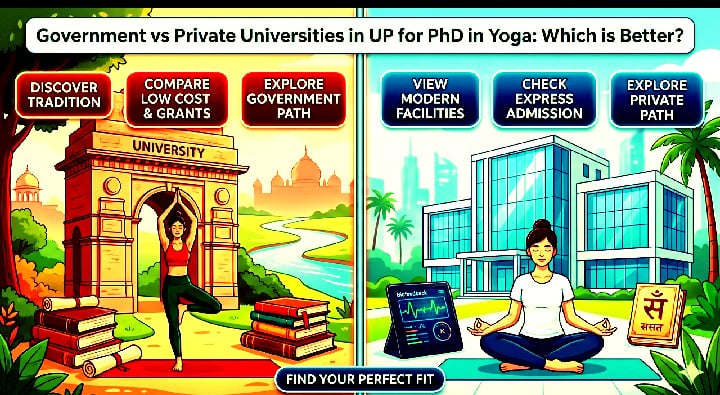
When we talk about government universities in UP, names like Banaras Hindu University (BHU) or Lucknow University immediately pop up. These places have a certain "vibe." It’s a mix of old-world charm, massive libraries with dust-covered manuscripts, and a lot of prestige. I have observed that people in India still look at a government degree with a special kind of respect. If you tell someone you’re doing your PhD at BHU, they usually give you a little nod of approval.
On the flip side, you have private giants like Amity University in Noida or Sharda University. These places feel like corporate offices. They have shiny glass buildings, air-conditioned labs, and fast Wi-Fi. I feel that the choice between these two is a lot like choosing between a vintage, hand-cranked Jeep and a brand-new Tesla. Both get you to the destination, but the ride feels completely different.
In a government setup, you often find yourself dealing with "the system." You might wait in a long line to get a signature from a clerk who is on a lunch break. But you also get to learn from professors who have literally written the textbooks. Private universities usually move much faster. They want you to finish on time because, well, time is money for them.
Cost and Fees for PhD Yoga in Uttar Pradesh
Let’s talk about the elephant in the room: the money. This is usually the biggest deal-breaker for most of us. In my experience, the price gap between a government seat and a private one is absolutely wild.
If you manage to crack the entrance for a place like BHU, you might pay somewhere around ₹10,000 to ₹12,000 per year. For a three-year PhD, you’re looking at maybe ₹35,000 total. That is practically a steal! It leaves you with enough money to actually buy books, travel for research, or just live your life without a mountain of debt.
Now, look at the private side. Amity University in Noida, for example, charges quite a bit more. As of 2026, you might be looking at around ₹1.2 Lakhs to ₹1.7 Lakhs just for the first year. By the time you finish, you could easily spend ₹4 Lakhs to ₹5 Lakhs on tuition alone.
I have observed a friend of mine, let’s call him Rahul, who went through this exact struggle. Rahul wanted the prestige of a government university, but he didn't want to wait for the slow admission cycle. He chose a private university because he could afford it and he wanted the "express" experience. He had a great supervisor and finished his work in exactly three years. Meanwhile, another friend, Priya, waited two years to get into a government university. She pays almost nothing, but she spends a lot of time chasing people for paperwork.
So, ask yourself: Do you have the patience to save money, or do you have the money to save time?
Admission Process and Research Quality
Let's explore this now. How do you actually get in? Most government universities in UP require you to pass the UGC NET or their own Research Entrance Test (RET). It is incredibly competitive. Thousands of students fight for just a handful of seats. If you have a JRF (Junior Research Fellowship), you’re in a great spot because the government will actually pay you to study.
Private universities also have entrance exams and interviews, but they usually have more seats available. They look for your passion and your ability to fund your research.
When it comes to research quality, it’s a bit of a toss-up. I feel that government universities excel in "Traditional Yoga." If you want to study ancient Sanskrit texts, Hatha Yoga lineages, or the philosophical roots of the Vedas, BHU or Lucknow University will give you resources that a private college simply can't match. They have archives that are centuries old.
Private universities, however, are often better at "Applied Yoga." They have the money to buy biofeedback machines, heart rate variability monitors, and other high-tech gadgets. If your PhD is about "The Effect of Yoga on Cortisol Levels in Corporate Employees," a private university with a modern lab might be a better fit. They focus on the science and the data, whereas government universities often focus on the soul and the history.
Career Opportunities and Networking
What happens after you get that "Dr." title in front of your name? This is where the road forks again. As far as reality is concerned, if you want a job as a professor in another government college, having a PhD from a state or central university is a huge advantage. The government hiring system often gives extra points to candidates from prestigious public institutions.
But if you want to work in the global wellness industry, start your own yoga therapy clinic, or work for a big international NGO, a private university might actually help you more. They have better "placement cells" and stronger connections with the corporate world. They teach you how to brand yourself and how to present your research to people who don't know anything about yoga.
I have observed that students in private universities often get more chances to attend international conferences. The university might even help pay for the flight. In a government college, you might have to fill out fifty forms just to get permission to leave the campus for a week.
Which One Should You Choose?
My dear friends, there is no single "right" answer here. It really comes down to your personality.
Choose a Government University if:
You are on a tight budget.
You have a JRF or a high NET score.
You love deep, traditional research and Sanskrit texts.
You have the patience to deal with slow administration.
You want to work in the public sector later.
Choose a Private University if:
You want a fast, streamlined process.
You need modern technology and lab equipment for your research.
You prefer a professional, corporate-style environment.
You have the funds to pay higher tuition.
You want to work in the private wellness or healthcare industry.
I remember talking to a professor last year who said something that stuck with me. He said, "The university gives you the desk, but you have to write the thesis." At the end of the day, your PhD is your own work. Whether you’re sitting in a 100-year-old stone building in Varanasi or a shiny glass tower in Noida, your dedication is what makes the research "better."
In my experience, the supervisor you choose matters more than the name of the university. Find a mentor who actually cares about your topic. A great guide in a small private college is a thousand times better than a famous professor in a big government university who never has time to read your emails.
Before you make a final call, go visit the campuses. Talk to the current PhD scholars. Ask them the "ugly" questions: How long does it take to get a thesis signed? Does the Wi-Fi actually work? Is the library open on weekends? These small things will be your reality for the next few years.
Good luck with your journey! It’s a beautiful path to take, and no matter which door you walk through, you’re doing something amazing for the world of Yoga. I’m rooting for you!
Contact
rkyogablog@gmail.com