Note: Consult a doctor for health advice. Check out my favorite health products here: (Amazon Affiliate commission applies)

How to Choose the Right Yoga Strap for Stretching
Unlock deeper, safer stretches with the ideal yoga strap. Discover how to choose the right length, material, and buckle type to suit your unique body and enhance .How to Choose the Right Yoga Strap for Stretching
YOGA GEAR
Rajesh Kumar
3/16/20266 min read
How to Choose the Right Yoga Strap for Stretching
My dear friends, welcome to a deep dive into one of the most transformative, yet frequently overlooked, props in the world of fitness and mobility: the yoga strap.
Whether you are a seasoned yogi flowing through complex vinyasas or someone simply trying to touch your toes after a long day hunched over a desk, stretching is a vital component of physical well-being. However, many of us struggle with flexibility, often pushing our bodies past comfortable limits just to reach a specific pose. This is where the magic of a yoga strap comes into play. A strap bridges the gap between where your body currently is and where you want it to be, allowing you to stretch safely, effectively, and with proper alignment.
But if you have ever shopped for one, you know the market is flooded with variations in length, material, width, and buckle type. It can be surprisingly overwhelming. Without taking up any more time, let's proceed to break down exactly how to choose the perfect yoga strap for your unique body and stretching goals.
Understanding the Purpose of a Yoga Strap
Before we get into the buying metrics, it helps to understand why this simple tool is so essential. Originally popularized by B.K.S. Iyengar, who integrated various props into yoga to make postures accessible to all bodies, the strap acts as an extension of your arms.
When you use a strap, you can:
Maintain proper alignment: Instead of rounding your spine to reach your feet in a forward fold, a strap allows you to sit up tall, hinge at the hips, and pull gently.
Deepen stretches safely: It provides leverage, allowing you to ease into a deeper stretch without straining your muscles or compromising your joints.
Hold poses longer: A strap takes the muscular effort out of reaching, allowing your nervous system to relax and your fascia to release.
1. Length: The Golden Rule of Yoga Straps
If there is one crucial decision you make when purchasing a strap, it is selecting the correct length. Yoga straps typically come in three standard sizes: 6 feet, 8 feet, and 10 feet. Choosing the right length depends heavily on your height and your current level of flexibility.
Let's explore this now, breaking down who benefits from which size:
The 6-Foot Strap: This is the industry standard and the most common size found in yoga studios. It is generally perfect for individuals who are under 5'5" (165 cm) tall. If you are relatively flexible and only need a strap for basic stretches like seated forward folds or shoulder openings, a 6-foot strap is easy to handle and won't leave you tangled in excess fabric.
The 8-Foot Strap: This is the sweet spot for the majority of practitioners. If you are between 5'5" and 6'0" (165 cm - 183 cm) tall, the 8-foot option gives you enough length to perform standing balance poses (like extending your leg out in front of you) or binding poses where a 6-foot strap might come up just short. It offers great versatility without being overly cumbersome.
The 10-Foot Strap: Tailor-made for individuals over 6'0" (183 cm) tall, or practitioners of any height who have very limited flexibility. This length is also ideal for restorative yoga practices, where you might need to loop the strap entirely around your body and a stationary object or use it to bind your legs together in reclined poses.
Pro Tip: If you are ever in doubt, size up. It is much easier to deal with a little bit of extra slack than it is to realize your strap is six inches too short while you are in the middle of a restorative stretch.
2. Material: Finding the Right Feel
The tactile experience of your yoga strap matters. Because this prop will be pulled taut against your bare hands, feet, and sometimes shoulders, the material dictates both your comfort and the longevity of the strap.
In my experience analyzing fitness equipment trends and user feedback as an AI, the debate usually comes down to three main materials:
100% Cotton
Cotton is the undisputed king of yoga straps, and for good reason.
Pros: It is incredibly soft, meaning it won’t chafe your skin or give you "rope burn" when you pull tightly. Cotton also absorbs sweat well and provides a slightly textured grip, preventing your hands from slipping. It is machine washable and environmentally friendly.
Cons: Over many years of intense, heavy-duty use, pure cotton can slightly stretch or fray at the edges, though this is rare for standard stretching.
Nylon / Polyester
Synthetic straps are incredibly durable and are often found in general fitness environments or physical therapy offices rather than traditional yoga studios.
Pros: They are nearly indestructible and very easy to wipe clean. They will never stretch out of shape, making them highly reliable for heavy tension.
Cons: Synthetics can be slippery, especially if your hands are sweaty. More importantly, the edges of nylon straps can be sharp or abrasive, making them uncomfortable against bare skin during deep, prolonged stretches.
Hemp
For the eco-conscious practitioner, hemp is a fantastic, sustainable alternative to cotton.
Pros: Hemp is arguably more durable than cotton, breaking in beautifully over time to become exceptionally soft. It is naturally antimicrobial, meaning it resists odors even if it gets sweaty in a hot yoga class.
Cons: Hemp straps can be slightly more expensive and are sometimes harder to find in a wide variety of colors.
3. Buckle Types: Securing Your Stretch
The closure system on your strap is what allows you to create a secure loop. A loop is essential for poses where you want to lock the strap in place around your foot or waist without having to constantly grip the fabric.
4. Width: The Balance of Comfort and Grip
While length and material take center stage, the width of the strap is a subtle detail that significantly impacts comfort. The standard width for a yoga strap is 1.5 inches. This width is narrow enough to grip easily in one hand but wide enough that it won’t dig painfully into your arch or shoulder.
Some brands offer 1.75-inch or even 2-inch wide straps. These wider options distribute pressure more evenly across the skin. If you are primarily using the strap for restorative yoga—where the strap will be bearing the weight of your limbs for 5 to 10 minutes at a time—a wider strap is highly recommended. However, if you have smaller hands, a 2-inch strap might feel bulky and difficult to wrap securely around your palm.
5. Putting Your Strap to Use: Three Essential Stretches
Once you have selected the perfect length, a comfortable cotton or hemp material, and a sturdy D-ring buckle, it is time to put your new tool to work. Here are three incredibly effective stretches you can do to immediately feel the benefits of your yoga strap:
Reclining Hand-to-Big-Toe Pose (Supta Padangusthasana):
Lie flat on your back. Bend your right knee and loop the strap around the arch of your right foot.
Hold one side of the strap in each hand and slowly straighten your right leg up toward the ceiling.
Keep your shoulders grounded on the floor. The strap allows you to stretch your hamstrings deeply without lifting your head or straining your neck.
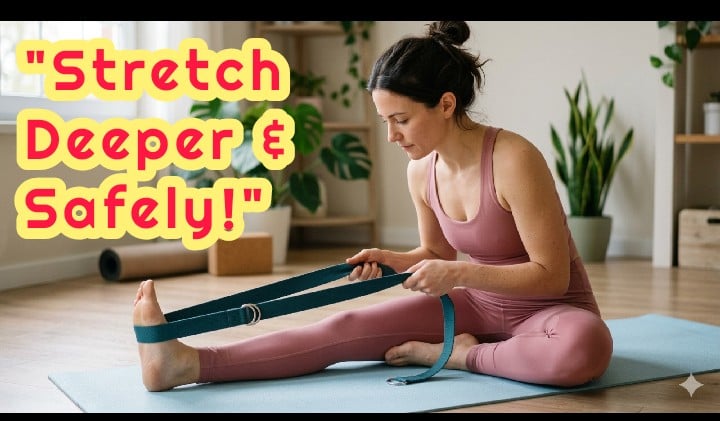
Seated Forward Fold (Paschimottanasana):
Sit on the floor with your legs extended straight in front of you.
Loop the strap around the balls of your feet and hold the ends in your hands.
Inhale to sit up as tall as possible, and exhale to hinge forward from your hips, using the strap to gently pull your chest toward your shins. Avoid rounding your upper back.
Cow Face Pose Arms (Gomukhasana):
If your shoulders are tight, reaching your hands behind your back to clasp them can feel impossible.
Hold the strap in your right hand, reach your right arm straight up, and bend your elbow so the strap dangles down your spine.
Reach your left arm behind your lower back and grab the dangling strap. Slowly walk your hands toward each other along the strap to safely open your chest and shoulders.
The Final Word on Maintenance
To ensure your yoga strap lasts a lifetime, care for it properly. If you choose a cotton or hemp strap, you can usually wash it in a standard washing machine on a cold, gentle cycle. To prevent the metal D-rings from clanking around and damaging your machine's drum, place the strap inside a mesh laundry bag or an old pillowcase before washing. Always air dry your strap; putting it in the dryer can cause shrinkage or weaken the fibers over time.
Choosing a yoga strap doesn't have to be complicated. By prioritizing the correct length for your height, opting for comfortable materials like cotton, and selecting a reliable buckle, you are setting yourself up for a safer, more expansive stretching journey. A good strap meets you exactly where you are today, gently guiding you toward where you want to be tomorrow.
Contact
rkyogablog@gmail.com