Note: Consult a doctor for health advice. Check out my favorite health products here: (Amazon Affiliate commission applies)

The Best Time of Day to Meditate for Maximum Benefits
Struggling with meditation? Discover how the timing of your sessions—morning, afternoon, or evening—can affect your practice. Learn to find the perfect meditation routine that fits seamlessly into your daily life.The Best Time of Day to Meditate for Maximum Benefits
MEDITATION
Rajesh Kumar
5/25/20265 min read

My dear friends, have you ever tried sitting down to clear your mind, only to end up thinking about your grocery list, that weird comment your coworker made in 2019, and what you’re having for dinner? I’ve been there more times than I care to admit. When I first started trying to meditate, I thought I was doing it all wrong. I would force myself to sit cross-legged on the floor at 11:00 PM, eyes watering from exhaustion, fighting off sleep while trying to find inner peace. Spoiler alert: it didn’t work. I usually just woke up an hour later with a stiff neck.
That disaster taught me a major lesson. Timing matters. In my experience, choosing the right hour to sit quietly can completely change your relationship with meditation. It can mean the difference between a frustrating session where your brain feels like a cage of caffeinated monkeys, and a peaceful moment that sets a beautiful tone for your whole day.
Let’s explore this now and figure out how you can find that perfect sweet spot for your own schedule.
The Magic of Early Morning Meditation
There is a reason why yogis and monks have been waking up before the sun for thousands of years. I used to hate morning people. I felt that anyone smiling before 8:00 AM was hiding something. But out of sheer desperation to fix my chaotic daily routine, I tried waking up just twenty minutes earlier to meditate.
As far as reality is concerned, the early morning has a very specific kind of quiet that you cannot find at any other time of day. The world hasn't fully woken up yet. Your email inbox isn't buzzing, nobody is texting you, and the streets are still relatively calm.
When you meditate first thing in the morning, you catch your brain in a unique state. You just came out of sleep, so your analytical mind hasn't fully booted up yet. You haven't started stressing about your to-do list. I feel that meditating right after you wake up acts like a protective shield for your mind. You are choosing peace before the chaos of the world has a chance to dictate your mood.
I have observed that when I start my day this way, I handle stress much better. If someone cuts me off in traffic later that morning, I just shrug it off. If I skip my morning session, that same traffic incident might ruin my whole hour. It sets a baseline of calm that carries you through the afternoon.
Defeating the Midday Slump with Afternoon Mindfulness
Now, let's look at another popular option. Imagine it is 2:30 PM. You just ate lunch, you have been staring at a computer screen for hours, and your energy takes a massive nosedive. Most people reach for a third cup of coffee or a sugary snack to survive the rest of the workday. I used to do exactly that, and it always led to a terrible jittery crash around 5:00 PM.
Without further ado, let's proceed to an alternative: the afternoon reset.
Taking ten or fifteen minutes to meditate during your lunch break or right before the late-afternoon rush can do wonders for your focus. I like to think of it as hitting the refresh button on a glitchy internet browser. Your brain gets cluttered with data, decisions, and conversations as the day goes on. A midday meditation clears out that mental garbage.
I started doing this when I worked a intense office job. I would literally lock myself in an empty conference room or even sit in my parked car for ten minutes. I didn't do anything fancy. I just closed my eyes and focused on the feeling of my breath going in and out. When I opened my eyes, the brain fog had lifted. It gave me a second wind to finish my tasks without relying on caffeine.
Unwinding with Evening and Nighttime Reflection
If you are a night owl, the morning routine might sound like absolute torture. That is completely fine. The evening offers its own special benefits for a mindfulness practice.
Think about how you typically end your day. A lot of us park ourselves in front of the TV, scroll through social media, or watch the news. We pour all this loud, stressful stimulation into our brains right before we expect our bodies to fall asleep. Then we wonder why we toss and turn all night.
Evening meditation acts as a beautiful bridge between the busyness of the day and the deep rest of sleep. It allows you to process everything that happened. If you had a tough conversation with your boss, or a stressful argument with a family member, you can sit with those feelings and let them go.
I have a friend named Sarah who swore she couldn't meditate. She tried the morning route and just fell back asleep. I suggested she try an evening practice right before bed. She started doing a simple body scan meditation—where you just focus on relaxing each part of your body from your toes to your head—while lying in bed. Now, she sleeps like a baby. It signals to your nervous system that you are safe, the day is done, and it is finally time to relax.
Matching Your Meditation Time to Your Specific Goals
So, how do you choose? In my experience, the best time to meditate depends heavily on what you actually want to get out of the practice. We all have different lives, different stress levels, and different goals.
If your main goal is to reduce overall anxiety and start your day with a clear, focused mind, aim for the morning. You want to build that wall of calm before the world throws its challenges at you.
If you suffer from high stress during the workday, feel overwhelmed by tasks, or hit a massive wall of fatigue after lunch, then a midday session is your best bet. It breaks up the day and prevents you from carrying morning stress into your evening.
If you struggle with insomnia, racing thoughts at night, or turning off your brain when your head hits the pillow, focus on an evening or nighttime routine.
There is no single correct answer here. I think people get too caught up in the "rules" of meditation. They think they have to do it perfectly, at the exact same minute every day, or it doesn't count. That mindset completely defeats the purpose. Meditation should reduce your stress, not create a new chore on your checklist.
Consistency Trumps the Clock Every Single Time
I want to share an important truth that took me years to fully understand. The clock matters much less than your commitment.
Let's say you decide that 6:00 AM is the absolute best time to meditate. You set your alarm, but you sleep through it twice a week. When you do wake up, you feel guilty, annoyed, and rushed. In that scenario, 6:00 AM is actually the worst time for you.
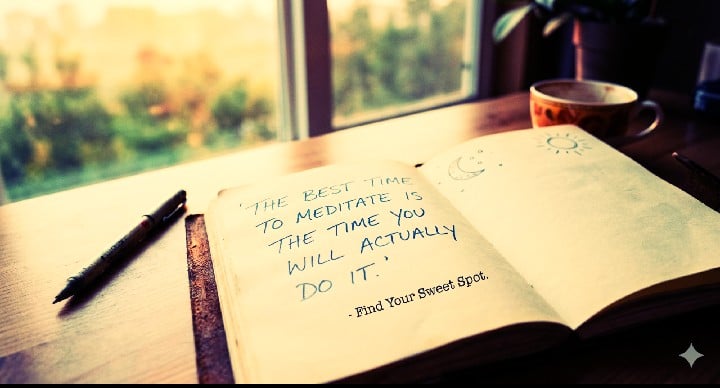
The best time of day to meditate is simply the time that you can actually stick to consistently. If that means 11:15 AM right before your morning meeting, great. If it means 4:00 PM when you get home from work, wonderful. If it means 9:00 PM after the kids go to bed, perfect.
I used to think that a five-minute meditation was pointless. I thought I needed at least thirty minutes for it to do anything beneficial. But I was totally wrong. A consistent five-minute daily practice will do far more for your brain than a thirty-minute session that you only manage to do once a month.
Treat your meditation time like an appointment with a dear friend. You wouldn't constantly blow off a friend because you were too busy, right? Show yourself that same respect. Pick a time slot that fits into your current lifestyle, not the lifestyle you wish you had. Start small, be kind to yourself when your mind wanders, and keep showing up. You will start noticing the benefits sooner than you think.
Contact
rkyogablog@gmail.com